Ways of Seeing: John Berger's Guide to Looking
Most museum visits begin with a caption, a wall text, or a phone screen that already tells you what the painting means. John Berger’s Ways of Seeing starts earlier: with the act of looking itself. First published in 1972 from a BBC series that answered Kenneth Clark’s Civilisation, the book remains a sharp, short education in how images work — oil paintings, nudes, reproductions, and advertising — and how ownership, gender, and publicity shape what we think we see.
Author: John Berger
Title: Ways of Seeing (Penguin Modern Classics)
Format: Kindle eBook (English), based on the 1972 BBC series
Scope: Seven essays on looking, ownership, the nude, and publicity
Amazon: amzn.to/479RE0H (ASIN B002ZJSV78)
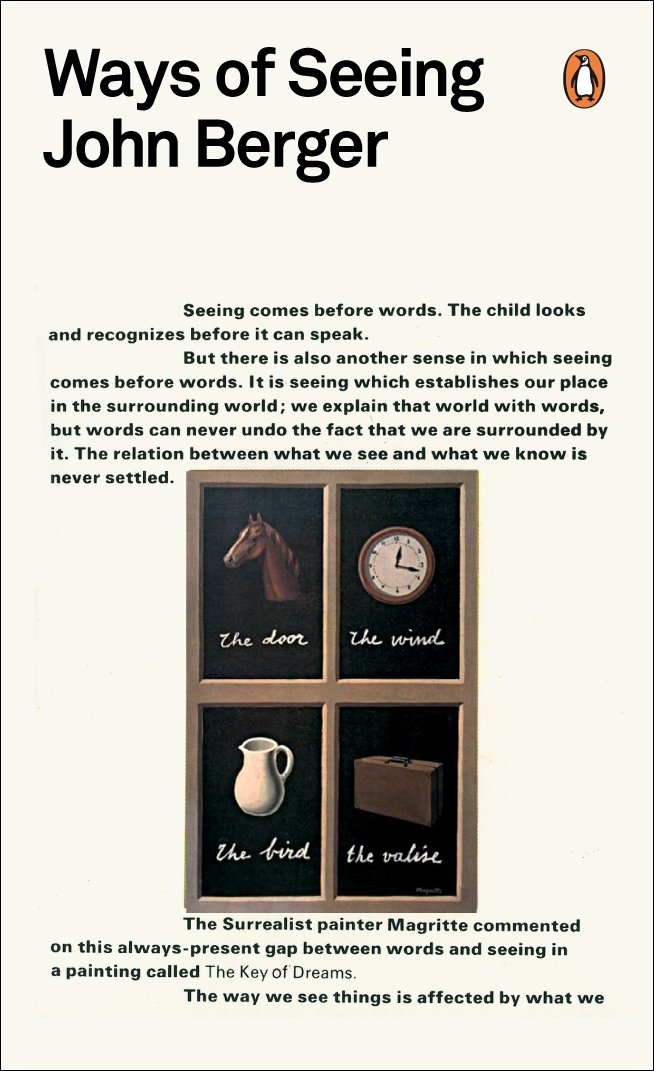
Seeing Comes Before Words
Berger’s opening claim is simple and hard to shake: seeing comes before words, and the relation between what we see and what we know is never settled. Looking is a choice; we never look at just one thing, but at the relation between things and ourselves. From there he shows how mechanical reproduction — the camera, the printed page, the cropped detail — changed paintings forever. A work that once lived in one place, at one scale, now travels as an image that can be rearranged, captioned, and set next to anything else. That is not a complaint against museums or books. It is a reminder that the frame around a picture (including this essay) is already part of the argument.
Ownership, the Nude, and Publicity
Later essays press on what oil painting historically advertised: possession — land, objects, status, and, too often, women presented as property for the male gaze. Berger then turns to modern publicity: ads that borrow the grammar of oil painting to sell envy and a future self you do not yet own. The book is short enough to finish in an evening and dense enough to argue with for years. Three of its seven essays are almost entirely images, so the form matches the thesis: you have to look, not only read about looking.
Why It Belongs Next to Gombrich on the Shelf
Sapiens Verbum’s Commented Paintings essays linger on single canvases — a Rubens charge, a Leonardo ermine, a Tiepolo goldfinch. The Story of Art by E.H. Gombrich gives the long historical map. Berger gives the critical habit that sits beside both: question how the image reaches you, who it was made for, and what the surrounding words are doing. Pair Ways of Seeing with any post on sapiensverbum.com, or with a print from prints.sapiensverbum.com, and the wall stop becomes less about memorizing a date and more about noticing the terms of your own looking.
As an Amazon Associate, this site earns from qualifying purchases.
Part of the reading recommendations featured on books.sapiensverbum.com.

