Contact: Carl Sagan’s Novel of a Message from Vega, Science and Faith
Ellie Arroway, a young astronomer convinced that intelligent extraterrestrial life exists, faces the scepticism of the scientific community about Project Argus, a radio-listening programme in New Mexico that she and her team are trying to save by every means. Until the day their computers pick up a rational message sent not from Earth, but from Vega, a distant star.
Author: Carl Sagan (1934–1996)
Title: Contact (1985)
Format: English paperback (Little, Brown), 416 pages
Scope: Science fiction novel about first contact
Amazon: www.amazon.es/dp/0356518841 (ASIN 0356518841)
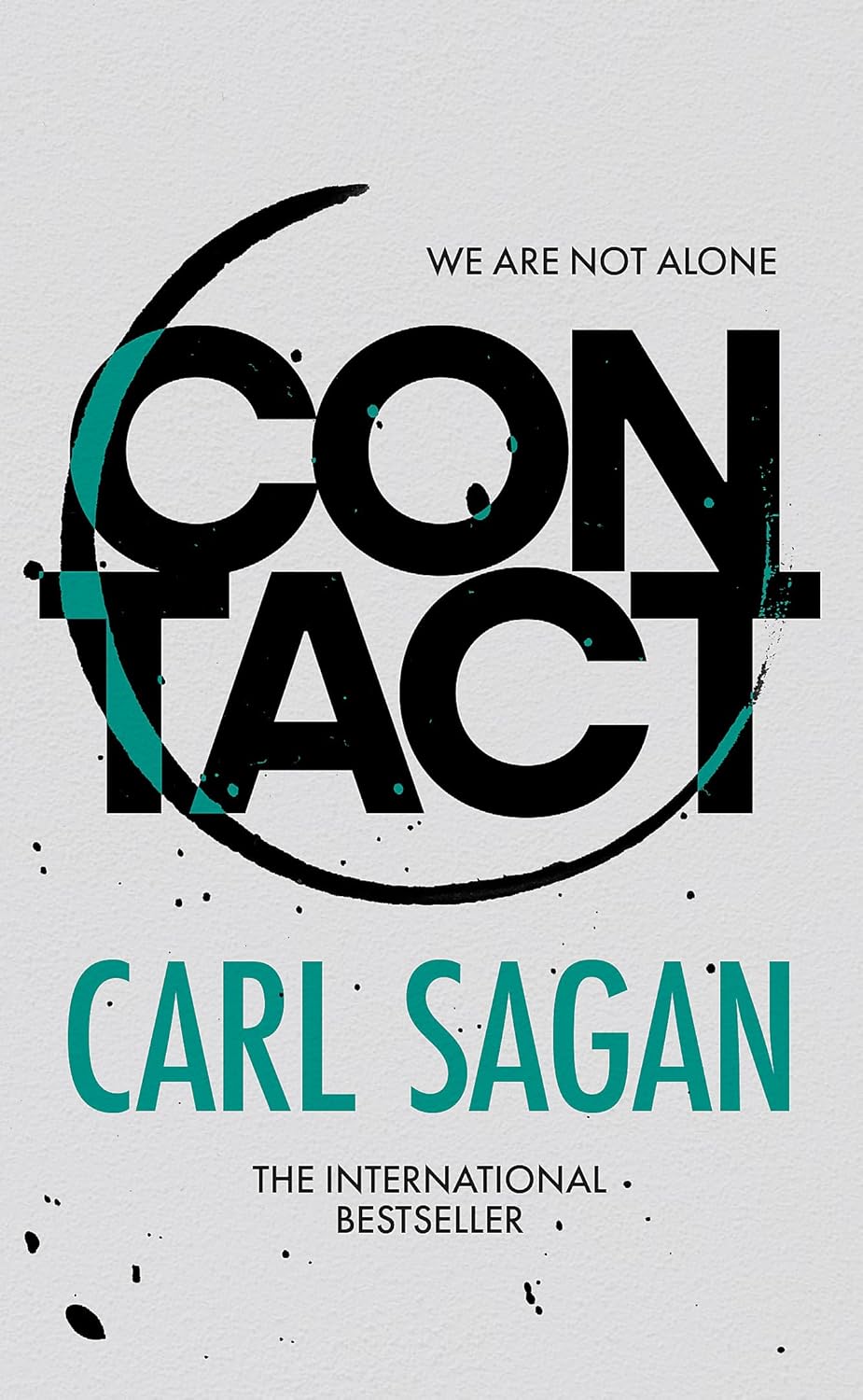
The Message
Ellie throws herself into decoding the message, which appears to contain instructions for building a machine: the plans for a vehicle that would let humans travel through space to meet those who sent it. These beings now seem eager to make contact. They have been watching us for a long time, and perhaps it is time for them to judge us... World leaders are persuaded to build the machine, which many see as a Trojan horse.
Big Questions
The story raises many questions about the beginning of the universe, our place in it, the limits of human understanding and other existential problems, and makes us question the slow progress of the scientific techniques used in astronomical observation. It also raises religious questions, comparing the different world views of the countries that collaborate on the project. The search itself turns out to be more than anyone expected, stretching the limits of scientific knowledge. In the process, Ellie discovers a completely different kind of religion and faith, one that works together with her scientific logic.
Prime Numbers and a Broadcast
Sagan imagines the first contact in careful detail. The signal comes from the direction of the star Vega and begins with a sequence of prime numbers, something no natural process would produce. Then the scientists discover a second layer: a television broadcast from Earth itself, the opening of the 1936 Berlin Olympics, one of the first transmissions strong enough to escape the planet, sent back to show that it has been received. Beneath that lies the third layer, the design for the Machine. The sequence feels plausible because it is built on how real radio astronomers think about interstellar communication.
Science and Faith
Ellie’s antagonist is not a villain but a range of human responses. Her ambitious former mentor, David Drumlin, tries to take over the project; Palmer Joss, a charismatic preacher, becomes both her opponent and her friend; an eccentric billionaire, S.R. Hadden, has plans of his own. Sagan, a declared sceptic, gives the religious characters serious arguments, and the novel’s ending turns the tables in a way that makes faith and evidence harder to separate than Ellie expected.
Sagan’s Novel
Carl Sagan was a Cornell astronomer, a key figure in NASA’s planetary missions and the presenter of the television series Cosmos (1980). He won a Pulitzer Prize for The Dragons of Eden and was a lifelong advocate of the search for extraterrestrial intelligence. Contact, his only novel, began as a film treatment written with Ann Druyan; when the film stalled, he turned it into a book. While writing it he asked the physicist Kip Thorne how his characters might travel vast distances, and Thorne’s answer, involving wormholes, helped spark serious research on the subject.
The Film
Robert Zemeckis’s 1997 film, starring Jodie Foster as Ellie, is one of the most respected science-fiction films of its decade. Sagan died in December 1996, before it was released. The film changes much, including the final revelation hidden in mathematics, so the novel still offers surprises.
The Journey
To give proof that will help an incredulous public take the project seriously, Ellie and a multinational team of scientists make a maiden voyage in the machine into deep space. When they return to Earth, they have to convince the religious and scientific communities that they are not the victims of a hoax. Sagan’s only novel is as thoughtful as his popular-science books, and far richer than the film it inspired.
As an Amazon Associate, this site earns from qualifying purchases.
Part of the reading recommendations featured on books.sapiensverbum.com.

