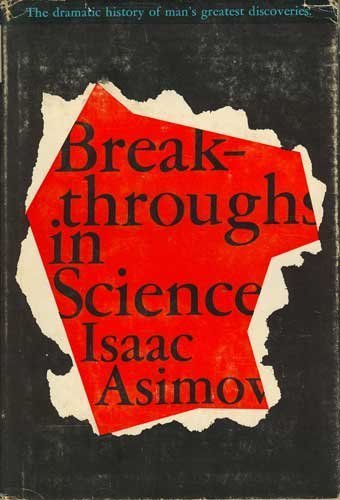
Breakthroughs in Science: Isaac Asimov’s Tour of the Great Ideas of Science
Driven by his interest in making science accessible, Isaac Asimov examines in Breakthroughs in Science (published in Spanish as Grandes ideas de la ciencia) the hypotheses and discoveries of leading figures throughout history that made possible the development of their fields of knowledge.
Author: Isaac Asimov (1920–1992)
Title: Breakthroughs in Science (1959); Spanish edition Grandes ideas de la ciencia
Format: English hardcover (Houghton Mifflin)
Scope: Short, accessible chapters on the scientists behind great discoveries
Amazon: www.amazon.es/dp/0395065615 (ASIN 0395065615)
A Tour Through Scientific Thought
Thales and Pythagoras in mathematics, Hippocrates in medicine, Linnaeus and Darwin in biology, Galileo in astronomy, Wöhler in chemistry, and Faraday, Rumford and Planck in physics: these are some of the examples Asimov uses to take the reader on an enjoyable journey through the evolution of scientific knowledge.
Asimov the Explainer
Asimov is best remembered for his science fiction, but he wrote hundreds of books, and many of them were about science itself. His gift was clarity: each chapter here tells the story of one idea through the person who had it, the problem they were trying to solve and why their answer mattered. No specialist knowledge is required.
Some of the Breakthroughs
Each chapter is a small drama. Hippocrates argued that disease had natural causes rather than divine ones. Linnaeus gave every living thing a two-part Latin name, creating the system of classification biologists still use. Count Rumford, boring cannon barrels in Munich, noticed that the friction produced endless heat and concluded that heat was a form of motion rather than a substance. Friedrich Wöhler made urea, a compound found in living bodies, from inorganic materials in 1828, breaking down the wall between organic and inorganic chemistry. And Max Planck, in 1900, proposed that energy comes in tiny packets, quanta, opening the door to modern physics.
Science as a Human Story
What Asimov does best here is show that science advances through people: their stubbornness, their luck, their mistakes and the problems they were trying to solve. That approach makes the book especially good for teenagers who think of science as a list of facts to memorise. It shows that every fact was once a question, and that the answer was not obvious.
Asimov the Polymath
Isaac Asimov was born in Russia in 1920, emigrated to the United States as a small child and trained as a biochemist, teaching at Boston University’s school of medicine. He wrote or edited around five hundred books, on everything from the Bible to Shakespeare. His longer histories of science, such as Asimov’s New Guide to Science and A Short History of Chemistry, also reviewed on this blog, are natural next steps for readers who enjoy this shorter introduction.
The Reviewer’s View
The original review praised the book for making the history of science enjoyable, and that is its great merit. Some details are inevitably dated, since it is more than half a century old, but the stories it tells have not changed.
Using It Today
Because each chapter stands on its own, the book is easy to dip into, a scientist at a time, and works well as background reading for school science or history projects. Readers who want to go further can follow any chapter into a full biography: of Darwin, Faraday or Galileo, for example. Asimov’s short portraits are a good map of where to explore next, and his enthusiasm is contagious.
Who Should Read It
It is an ideal first book on the history of science for teenagers and curious adults alike. The linked edition is an older US hardcover, since the book is now out of print in English; the Spanish translation is easier to find in Spain.
As an Amazon Associate, this site earns from qualifying purchases.
Part of the reading recommendations featured on books.sapiensverbum.com.

